
This guide explains how to connect your e-commerce website to Fiduly in order to synchronize your customer orders, contacts, products, prices, quantities, VAT, billing addresses, delivery addresses and order statuses.
Fiduly can be connected to a WooCommerce or PrestaShop store using an API key. Once synchronization is configured, your e-commerce orders can be imported automatically into Fiduly at regular intervals.
To go further, also see the guides manage stock, orders and purchases with Fiduly, manage customers and quotes with Fiduly and create and manage your invoices with Fiduly.
Before connecting your store to Fiduly, create an API key in your e-commerce platform. This key allows Fiduly to access the information required for synchronization.
Depending on your store, see the official documentation:
For WooCommerce, the API key is generally created from the WooCommerce settings, in the advanced section dedicated to the REST API. WooCommerce recommends using HTTPS to access the API whenever possible.
For PrestaShop, API access is configured from the “Webservice” section in the advanced settings, then by creating a new webservice key.
In the Fiduly navigation menu, go to “Settings”, then open “eCommerce”.
For security reasons, API settings are no longer displayed by Fiduly after they have been saved. Do not click “Update” again without entering the values, to avoid deleting your configuration.
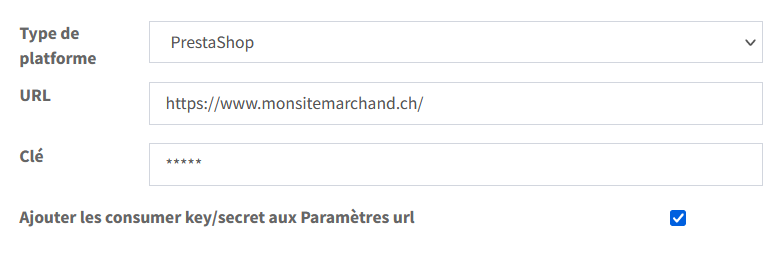
Once the connection has been configured, you can manually synchronize certain data or enable automatic order synchronization.
If a contact with the same email address already exists in Fiduly, it will not be imported a second time. If an order belongs to a new customer, Fiduly can create the contact automatically.
Fiduly synchronizes the information contained in orders: customer, billing address, delivery address, ordered products, prices, VAT, quantities, discounts and order status.
The e-commerce order status is imported into Fiduly in the “Situation” section, depending on your store configuration.
Find answers to the most frequently asked questions about connecting WooCommerce or PrestaShop, API keys, and synchronizing customers, products, orders, stock and statuses in Fiduly.
Fiduly allows you to connect a WooCommerce or PrestaShop store using an API key.
You need to create an API key in WooCommerce or PrestaShop, then enter the API settings in Fiduly from “Settings”, then “eCommerce”.
Fiduly can synchronize customers, products, orders, billing addresses, delivery addresses, prices, VAT, quantities, discounts and order statuses.
Yes. If an order belongs to a new customer, Fiduly can import this customer. If a contact with the same email address already exists, it is not imported a second time.
Yes. You can manually synchronize products from Fiduly’s e-commerce settings.
Yes. You can enable automatic order synchronization by switching the corresponding option to “ON”.
Yes. Fiduly can import the e-commerce order status into the “Situation” section.
To go further, also see the guides related to orders, customers, stock, invoicing and accounting.